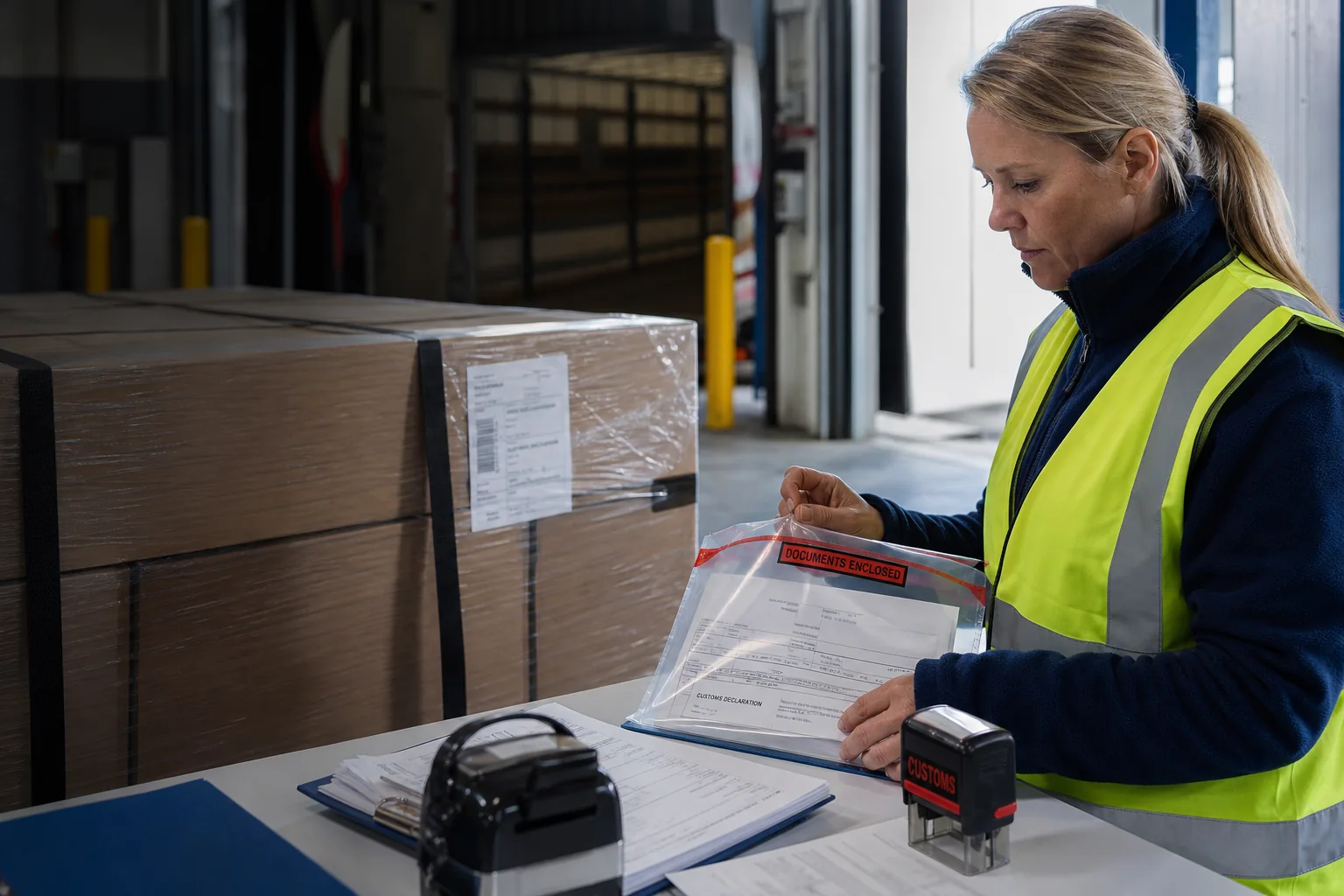
Since Brexit, every UK e-commerce business that imports stock is an importer in customs terms, even if it only buys a few pallets from a supplier in the EU or the Far East. That status brings three practical requirements: a GB EORI number, a customs declaration for each consignment, and a choice about how the import VAT is accounted for. This piece closes the cross-border cluster and sits alongside the companion guides on reclaiming import VAT with C79 and PVA and the Import One-Stop Shop for low-value EU sales.
What an EORI number is and how to get one
An Economic Operators Registration and Identification (EORI) number is the reference HMRC and customs use to identify a trader moving goods across the UK border. A UK business needs one that starts with GB to import or export goods into or out of Great Britain. A separate number starting with XI is needed for movements involving Northern Ireland. You apply free through GOV.UK, and HMRC typically issues the number within about a week, often sooner where the business is already VAT-registered.
A common mistake is leaving the EORI application until a shipment is already in transit. Without it, the freight agent cannot complete the declaration and the goods sit in a bonded warehouse accruing storage charges. The EORI is a one-off setup, so the sensible point to apply is when you first plan to import, not when the container arrives.
Get E-commerce Accounting Help
We specialise in UK online sellers across Amazon, Shopify, eBay, Etsy, and TikTok Shop. Tell us about your business and get a fixed quote within 48 hours. No obligation.
The Customs Declaration Service replaced CHIEF
UK import and export declarations are filed through the Customs Declaration Service (CDS), which fully replaced the older CHIEF system by March 2024. In most cases the declaration is made on the seller's behalf by a freight forwarder, courier or customs agent, using the seller's EORI number. The seller still needs to supply the information the agent declares: the commodity code, the customs value, the country of origin and the intended customs procedure.
Commodity codes and the UK Global Tariff
Each product is classified under a commodity code that determines the duty rate under the UK Global Tariff and any import controls. Getting the code wrong is one of the most common and expensive import errors, because it can mean underpaid or overpaid duty that surfaces on a later customs review. For a seller importing the same lines repeatedly, agreeing the correct commodity codes once and reusing them is the practical control. Where a classification is genuinely uncertain, HMRC offers an Advance Tariff Ruling that fixes the code in advance.
Postponed VAT Accounting keeps import VAT off your cash flow
Import VAT is charged on goods entering Great Britain at the same rate that would apply to a domestic sale. Before Brexit-era reforms, that VAT had to be paid at the border and reclaimed later, tying up cash. Postponed VAT Accounting (PVA) removes the upfront payment: instead of paying at the border, the importer accounts for the import VAT on its VAT return.
PVA is available to all UK VAT-registered businesses with no separate application or licence. The importer (or its agent) simply selects the PVA option on the CDS declaration. The import VAT is then declared as output tax in Box 1 of the VAT return and reclaimed as input tax in Box 4, so for a fully taxable business the two cancel out and no cash leaves the business for import VAT at all.
The monthly postponed import VAT statement is the evidence for the Box 1 and Box 4 entries, and it replaces the older C79 certificate for businesses using PVA. The mechanics of the statement and the C79 are covered in the import VAT reclaim piece.
Duty, value and the parts PVA does not cover
PVA covers import VAT, not customs duty. Where the commodity code carries a duty rate, that duty is payable and is not postponable in the same way, so it remains a real cost that should be priced into landed-cost calculations. The customs value the declaration uses is generally the price paid for the goods plus transport and insurance to the UK border, which means duty and import VAT are calculated on more than the invoice price alone. Sellers who price their products off the supplier invoice without adding freight and duty routinely under-cost their stock.
EORI for returns, exports and EU sales
The same GB EORI is used when goods leave Great Britain, whether that is a customer return going back to a supplier or stock exported to a fulfilment centre abroad. Selling physical goods to EU consumers is a separate question handled through import procedures in the destination country, the Import One-Stop Shop for low-value consignments, or local arrangements, rather than through the GB import mechanics described here. The cross-border VAT side of EU sales is covered across the rest of this hub.
Common questions about EORI and customs
Do I need an EORI number if I only sell digital products?
No. EORI numbers are for moving physical goods across the border. A business selling only digital products or services does not import goods and does not need one, although it will have its own VAT obligations on cross-border digital sales.
Can I use Postponed VAT Accounting if I am not VAT-registered?
No. PVA is only available to VAT-registered businesses, because it works by moving the import VAT onto the VAT return. A non-registered importer pays the import VAT at the border and cannot reclaim it, which is one practical reason importing businesses register for VAT.
Who is responsible if the customs declaration is wrong?
The importer of record carries the responsibility, even where an agent files the declaration. If the commodity code or value is wrong, HMRC pursues the importer for any underpaid duty or VAT. That is why it is worth checking the codes and values the agent uses rather than treating the declaration as entirely their problem.
Do I need a separate XI EORI number?
Only if you move goods to or from Northern Ireland under the relevant arrangements. A seller importing into Great Britain alone needs only the GB EORI. A business trading across the Irish Sea may need the XI number as well.
If imported stock is a regular part of your model, it is worth having an e-commerce accountant set up the EORI, the PVA process and the landed-cost calculation together, so the import VAT stays off your cash flow and your product margins reflect the true cost of getting goods to the UK.
Get E-commerce Accounting Help
We specialise in UK online sellers across Amazon, Shopify, eBay, Etsy, and TikTok Shop. Tell us about your business and get a fixed quote within 48 hours. No obligation.
E-commerce Accountants UK
Specialist E-commerce Accountants
All articles on this site are reviewed for technical accuracy by our qualified accountants before publication.