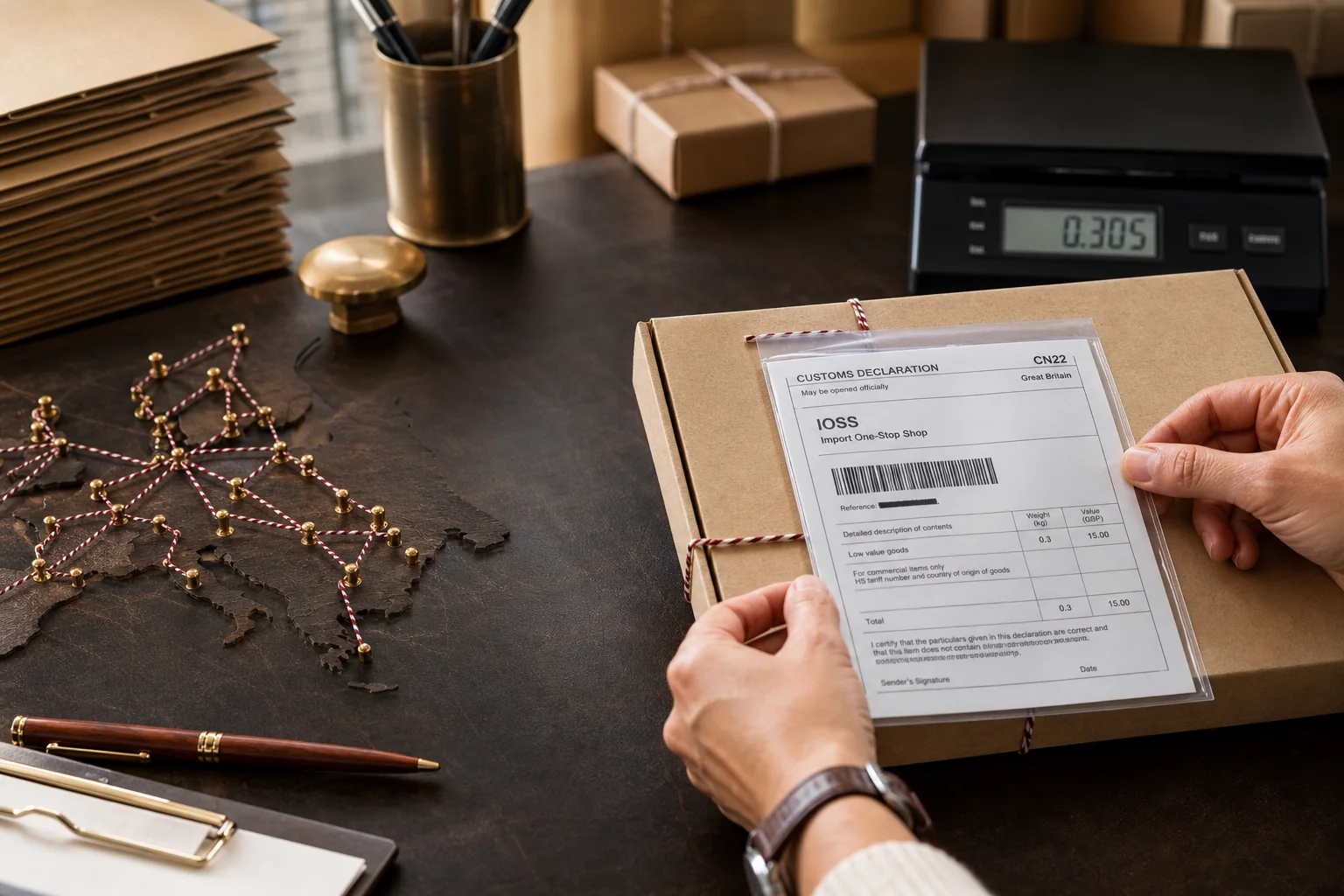
The Import One-Stop Shop (IOSS) is the EU's simplified VAT scheme for low-value B2C imports, in force since July 2021. It lets a UK seller charge destination-country VAT at checkout, submit a single monthly EU-wide VAT return, and have shipments below €150 clear EU customs without further VAT collection at the border. Without IOSS, packages either face import VAT at delivery (typically with a courier handling fee of €15-€20) or sit in customs while VAT documentation is sorted.
This piece walks the IOSS registration mechanism (UK sellers cannot register directly), the €150 threshold and what it includes, the monthly return, and the practical issues UK Shopify and Amazon sellers run into. Sister pieces in the cross-border VAT hub cover Pan-EU FBA local registrations and the C79 / PVA mechanism for UK import VAT recovery.
How IOSS works mechanically
- UK seller registers for IOSS through an EU-established intermediary (UK sellers cannot register directly post-Brexit).
- Intermediary issues an IOSS number, which the seller embeds in customs declarations on outbound packages.
- Seller charges destination-country VAT at the checkout (German 19%, French 20%, Italian 22%, etc.) on B2C consignments below €150.
- Single monthly IOSS return submitted to the registration country (often Ireland, Luxembourg, Netherlands), which distributes the VAT to the relevant member states.
- No VAT collected at the EU border; package clears customs cleanly with the IOSS number on the customs paperwork.
- Courier or postal carrier (Royal Mail, DPD, DHL, Evri) must support IOSS shipping labels; most major carriers now do.
Get E-commerce Accounting Help
We specialise in UK online sellers across Amazon, Shopify, eBay, Etsy, and TikTok Shop. Tell us about your business and get a fixed quote within 48 hours. No obligation.
The €150 limit and what counts
The €150 limit is the intrinsic value of the consignment (the goods value) excluding VAT, shipping, and insurance. A consignment with goods at €145, shipping at €15, and insurance at €5 (gross total €165) is inside IOSS because the intrinsic goods value is below €150. A consignment with goods at €155 is outside IOSS regardless of how cheap the shipping is; standard import VAT and customs apply, charged at the EU border with a handling fee.
Multi-line orders are tested at the consignment level, not the SKU level. An order containing three €60 items shipped together is one €180 consignment, outside IOSS. Sellers offering free shipping over €100 frequently push customers into the "above €150" trap accidentally, with the customer hit by an unexpected delivery-time VAT charge that triggers chargebacks and returns.
Choosing an IOSS intermediary
Marketplace IOSS vs own IOSS
Amazon, eBay, and Etsy operate their own IOSS schemes for sales through their platforms. The marketplace charges destination VAT, collects, and remits. The UK seller receives net-of-VAT settlement. This is mandatory for marketplace sales; the seller cannot use their own IOSS for these. Sales through the seller's own Shopify storefront or direct website remain on the seller's own IOSS registration. A multi-channel seller therefore typically operates with both routes in parallel.
The monthly IOSS return
The IOSS return is filed by the intermediary on behalf of the seller, due by the end of the month following the period. June sales are submitted by 31 July. The return is a country-by-country summary of taxable supplies, VAT at each country's rate, and total VAT due. Errors discovered later can be corrected on subsequent returns, but persistent errors trigger intermediary review and potentially termination of the IOSS registration.
When IOSS does not apply
- B2B sales (use OSS or local VAT registration depending on context).
- Consignments above €150 intrinsic value (standard import VAT and customs apply).
- Excise goods (alcohol, tobacco, perfume) regardless of value.
- Sales to non-EU destinations (use destination country rules).
- Returns and refunds (handled through monthly return adjustments).
IOSS and post-Brexit customs
IOSS handles the VAT side but does not eliminate the customs side. Every EU-bound consignment still needs an EORI number, a customs declaration (CN22 / CN23 for small packages, full customs declaration for higher value), and a commodity code on the goods. The IOSS number sits on the customs paperwork alongside the EORI and the commodity code. See EORI numbers and customs declarations post-Brexit for the customs side in detail.
What happens if I do not register for IOSS?
You can ship into the EU without IOSS, but every consignment will be held at customs until the destination customer pays import VAT and the carrier's handling fee. The customer typically learns about the VAT and fee for the first time when the courier emails or rings asking for payment before delivery. UK sellers operating without IOSS routinely see 20-30% of EU orders end in either refunds, chargebacks, or "return to sender" outcomes once the customer realises the total cost is materially higher than the checkout figure.
Is IOSS worth it for low EU volumes?
For a UK seller shipping fewer than 50-100 B2C consignments per month into the EU, the specialist IOSS provider fees (£25-£75 per month) often outweigh the abandoned-cart benefit. Marketplace-routing the EU sales through Amazon or eBay, both of which provide IOSS as part of the marketplace fee, is materially more economical at low volume. Above 100 EU consignments per month from a direct-to-consumer storefront, own IOSS becomes the standard answer.
Can I deregister from IOSS if EU sales drop?
Yes, deregistration is a written request through the intermediary, effective from the end of the month in which it is submitted. Final return covers the period up to deregistration date. Re-registration later requires a fresh setup, including a new IOSS number; the previous number is not reactivated. Most UK sellers expecting seasonal EU sales (Christmas-heavy categories) maintain year-round IOSS rather than deregister and re-register, because the admin cost difference is small.
Get E-commerce Accounting Help
We specialise in UK online sellers across Amazon, Shopify, eBay, Etsy, and TikTok Shop. Tell us about your business and get a fixed quote within 48 hours. No obligation.
E-commerce Accountants UK
Specialist E-commerce Accountants
All articles on this site are reviewed for technical accuracy by our qualified accountants before publication.